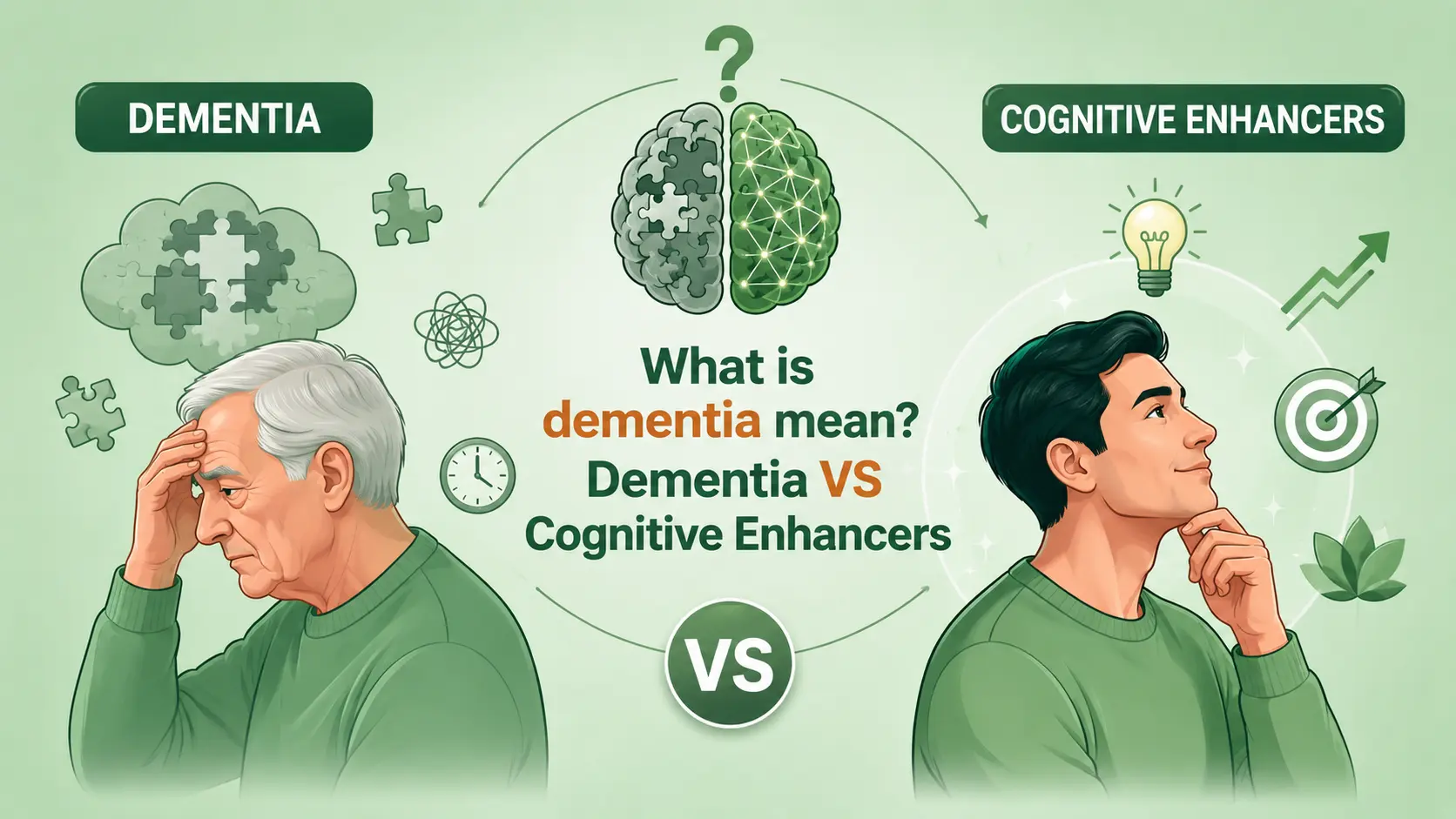
What is dementia mean? Dementia VS Cognitive Enhancers
On this page
- Getting the Definition Right
- The Many Faces of Memory Loss
- If it affects the Front Part of the Brain
- Catching it Early
- It’s not Always an Older Person’s Condition
- Creating the Right Support System
- Where Cognitive Enhancers are Applicable
- Why the Comparison Falls Apart
- The Bottom Line for Families
It’s a bizarre internet collision that happens when you start to Google a reason why your loved one has lost their memory and then you get to some of the students that are taking shift pills and focus pills.
Two totally different worlds and some bizarre intersections on the map of Google search results. That’s a quagmire that must be addressed immediately: people with a serious neurological disorder don’t need to take a pill to be more productive.
Getting the Definition Right
Dementia is not a disease, it is an umbrella term for a loss of memory, thinking and reasoning that is important enough to affect an individual’s functioning in daily living. It occurs when the brain cells are damaged and they no longer function in a normal manner and this eventually affects all aspects of life from talking to self-care.
It’s progressive, that is, symptoms get worse and worse but do not get better by themselves. Realizing that it is a simple framework and it’s not the same diagnosis, many of the confusions out there are due to people interpreting it as a singular, one-size-fits-all condition instead of a blanket term for a number of different diagnoses.
The Many Faces of Memory Loss
There are different conditions which have an impact on memory that don’t manifest or develop in the same way, so it is important to be diagnosed correctly. Vascular dementia is caused by damage to the brain from a decreased blood supply, which may be due to a stroke, or a series of smaller, less noticeable vascular events.
Lewy body dementia is characterized by abnormal protein deposits in the brain and often has certain symptoms such as visual hallucinations or extreme changes of alertness.
There are several types of dementia known to exist, most of them have a different onset, progression and treatment strategy and a symptom checklist is not a complete picture of the disease.
If it affects the Front Part of the Brain
There are forms that focus on areas that go beyond memory and instead address the area of personality, judgment and language. However, frontotemporal dementia can manifest itself in changes to behaviour and social interaction before any memory loss is present, which can lead to it being incorrectly diagnosed as a psychiatric disorder and not a neurological disorder.
Also called frontal lobe dementia, this type may be confusing to families because the person may be very different from the way he or she was before, but may have a good memory until later. One of the major reasons why it is crucial to properly assess a dog’s neurological function over assuming that it is, is the discrepancy between symptoms and expectations.
Catching it Early
Recognising early the changes in the family can have a significant impact on the nature of care and planning. Early signs of dementia may include losing things, not following what others are saying or repeating yourself.
These gradual changes gradually progress into more obvious signs of dementia such as being lost in familiar surroundings, financial or occupational problems, or withdrawal from social activities. The signs are not characteristic of any specific disease, however if they are present, the sooner these are discussed with a doctor, the better.
It’s not Always an Older Person’s Condition
This is often considered to be a problem for older age groups only, but this is not correct. When someone is diagnosed with dementia at an early age (before 65 years), this is known as early onset dementia, and can be particularly disruptive as it can happen while people are at work; sometimes while still in their family years.
Then there’s the emotional toll, which is often unique, as younger patients and their families are faced with career, financial and parenting issues that many are not anticipating at this stage. This fact is important to be aware of as young age can sometimes be a reason for being overlooked or misdiagnosed when experiencing symptoms.
Creating the Right Support System
Eventually, many families will require additional support, beyond what can be given at home, as the symptoms worsen. Memory care facilities are designed to meet the needs of the individual who experiences severe cognitive impairment, including trained staff, secure environments, and a schedule that caters to the needs of this phase.
The appropriate one is usually simply what one chooses, and includes a real visit and details about the ratio of employees to residents, and the way behavioral changes are managed as the disease advances. While it is typically not easy, the correct environment can make a big distinction in terms of safety and life standard.
Where Cognitive Enhancers are Applicable
But now it’s time to draw the line, and clearly distinguish between the two scenarios in the title. Brain boosting pills, as they are sometimes referred to, are prescription medications that are typically prescribed to help keep people awake and focused when they have some type of sleep or alertness disorder and are not meant to cure dementia or other neuro-degenerative diseases.
Armodafinil 250mg and various varieties of Artvigil (Artvigil 150mg, Artvigil 50 Mg and Waklert 150 Australia) are used to balance brain chemistry that affects alertness, and will not address the underlying damage seen in dementia. The problem of confusing the two categories isn’t only a mislabeling problem, it can be a problem of the right or wrong type of help that is sought by families.
Why the Comparison Falls Apart
Dementia is a structural change that progresses in the brain; enhancers are temporary structural changes in the brain that occur for a limited time that pass away in hours. One is just a medical condition, which is diagnosed and is a long-term specialized treatment that is used in very different ways, e.g. treating shiftwork sleep disorder or narcolepsy.
Nothing can be provided to anyone who suffers from actual cognitive decline, even if they are looking for a better focus aid, like Artvigil 250 Mg. But, in all honesty, it’s not a fair comparison, and as the saying goes, “it’s not great as a sales pitch to anyone seeking the truth.
The Bottom Line for Families
You should be diagnosed properly if you are experiencing memory or behavioral problems, or if someone you love is, before taking a pill for some other ailment. A neurologist or geriatric specialist can determine the condition that is actually causing your symptoms and suggest realistic choices for assistance, such as medication, lifestyle changes or ultimately making the decision to pursue dedicated care.
Cognitive enhancers: It’s a fine line between using them and near a dementia diagnosis. The most critical actions taken by an individual or family can be to get an early accurate diagnosis and then the proper treatment.